

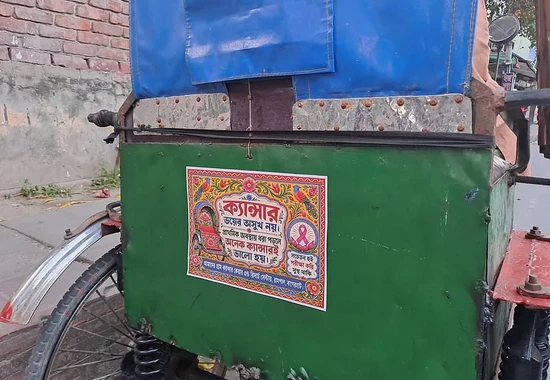
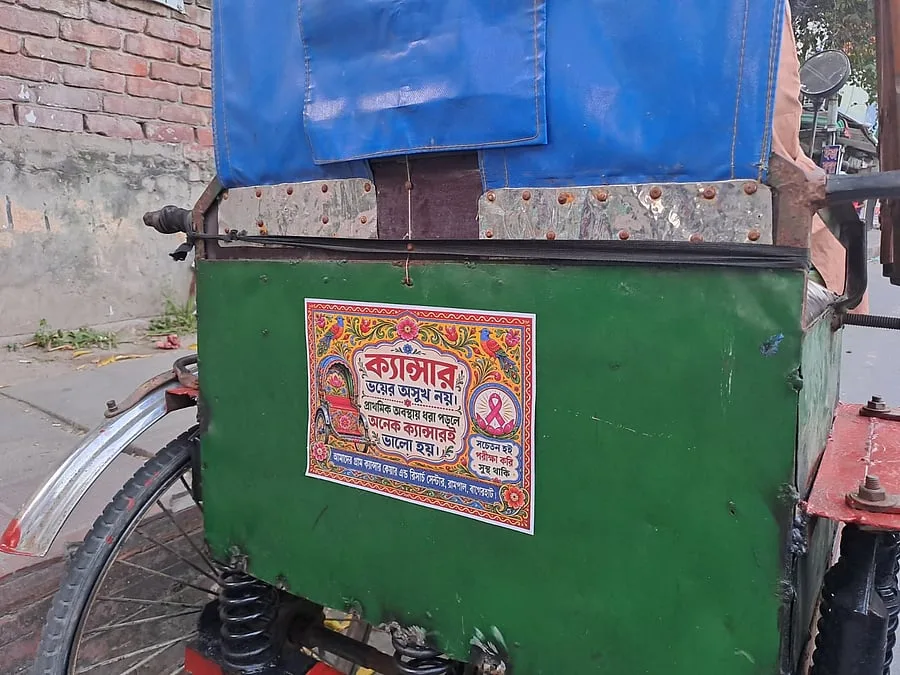
A traditional rickshaw painting in full colour — flowers, birds and vines beside a village home, a river and a sailboat. And across the middle, in large letters: “Not all tumors are cancer.” Through the Amader Gram ICT-for-rural-development project, the Amader Gram Cancer Care and Research Centre has turned Bangladesh's beloved rickshaw art into a medium of health education, showing how urgent health messages can travel through the local culture and the art language people already know.
Rickshaw paintings belong to everyday life and the streets. Using them to teach about illness, question misconceptions and encourage people to seek care opens a new possibility for health communication: the very art that colours daily travel can become the medium that starts conversations about health.
In Rampal, that idea is now being put into practice by the Amader Gram Cancer Care and Research Centre. The initiative of a rural medical facility, it uses traditional rickshaw paintings for cancer awareness and health education, and it has drawn a local response — pointing toward what is being called a Rampal model of health communication rooted in local art and culture.
The strength of the innovation lies in the choice of medium. By taking a form of art everyone recognizes and attaching urgent health messages to it, the project aims to start conversations about health beyond the clinic, in the flow of ordinary daily life.
Talking about cancer is not easy. For many people, the very word brings fear, uncertainty and helplessness, and medical information can become inaccessible through difficult terminology. A distance often remains between sharing information and making that information meaningful to people.
The organizers believe rickshaw paintings can narrow that distance. Bright colours catch the eye, familiar scenes feel personal, and short sentences are easy to remember. Instead of long instructions, a single simple message can stop people and make them think — and it can surface again in family talk or conversations on the street.
“Not all tumors are cancer” is an example of this approach in action. The line is meant to reduce unnecessary panic, blending a vital health message with the colour, creativity and familiar folk art of daily life to make it simple and meaningful.
The imagery matches the idea. Bright reds, blues, yellows and greens; birds, lotus flowers, rivers and rural nature — a serious health topic is placed within a familiar setting of life. The effort is visibly trying to create room for hope and humanity in conversations about cancer.
Another painting reads: “In sickness, mental strength is the biggest medicine.” In a familiar folk expression, it recalls the courage and emotional support ailing people need. Health education should also make clear that mental strength is not a substitute for treatment — listening to a patient, not leaving them alone, and helping them reach the care they need is what real support looks like.
The Rampal initiative raises an important question for health communication: how much do we use a person's own culture to reach them? The value of a local medium lies not only in its accessibility but in its connection to people's experience and identity. A familiar art form such as rickshaw painting can begin to draw attention to a health message; then health workers' discussions, courtyard meetings and local media can explain and expand it.
The effort also opens new possibilities for folk art itself. Putting rickshaw painting to work in contemporary public health can widen its social relevance and scope — a revival of tradition that happens through meaningful use in people's present lives. To make that lasting, the organization has planned an art camp in Rampal this winter, with the creative participation of local painters and an exhibition of the works produced at the camp.
The parent body, Bangladesh Friendship Education Society, was founded by the late Professor Mahmudul Haque, a Dhaka University fine arts professor and artist, whose connection between art and social service gives this initiative its special significance. The organization is currently led by its co-founder, development worker Reza Selim. Using rickshaw paintings in the work of bringing services and information to rural health systems is a creative addition to that tradition.
The Rampal experiment is a reminder that innovation in health education can come from within people's familiar world: Bengali rickshaw painting, plain language and the initiative of a rural medical centre together open that possibility. When the colourful picture on the road encourages someone to ask questions, talk about fear or seek proper advice, folk art becomes a companion on the journey to good health.
This feature was written by a health education research officer at the Amader Gram Cancer Care and Research Centre, Rampal, Bagerhat, and adapted from a report originally published by Prothom Alo. Republished by TechLife Team.





No comments yet. Be the first to comment!